
Accurate, easy, consistent, low cost predator monitoring.
We have been doing a few tests of our latest DOC AI camera that highlight just how easy predator monitoring is now.
The reason we developed this camera is that it is more sensitive for NZ predators so you can more accurately understand what is going on. In this test we put the cameras on a track that mainly has possums so the comparison trail camera should catch the same number of animals and the test is more about how much less effort is it to do monitoring i.e. get a consistent count of what is going on.
Set up
Trail camera - Bushnell CORE S-4K, high sensitivity, night mode, fast motion, 4:3 image format, 1920x1080, delay 0.5s,
DOC AI Camera, #A001
There is also an old style of our thermal cameras too (grey box)
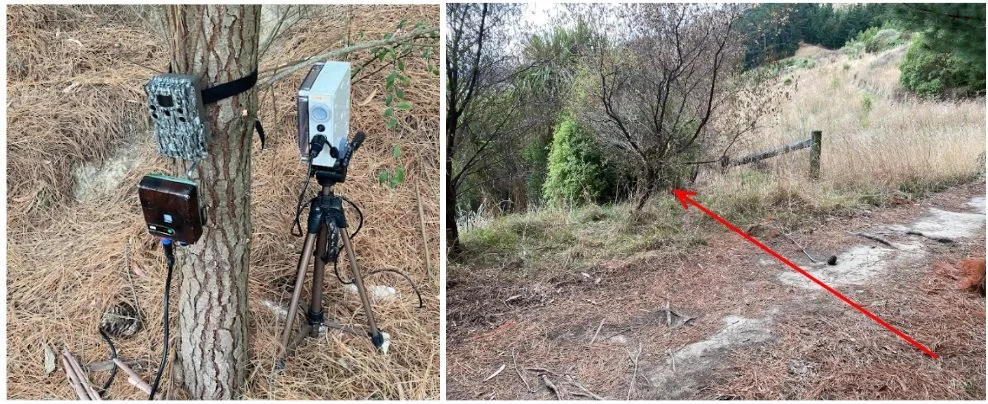
Camera test set up
Results
From the DOC AI camera it automatically produces a predator monitoring table. If your device is in cell phone range it will be sent to you as an email summary each morning. The table shows the number of predator visits to the site per day. The thermal camera took hundreds of videos but it turns a sequence of videos that are together into a “visit”. If there is a gap of less than 10 minutes between the videos it assumes it is the same animal. From the sequence of videos it then makes the best guess as to what the animal is. This removes the typical problem where when an animal is first detected it is not identifiable then as it wanders closer it is identifiable. All of the videos are then clumped together and it is counted as one visit. This all happens automatically to calculate how many animals have been seen.
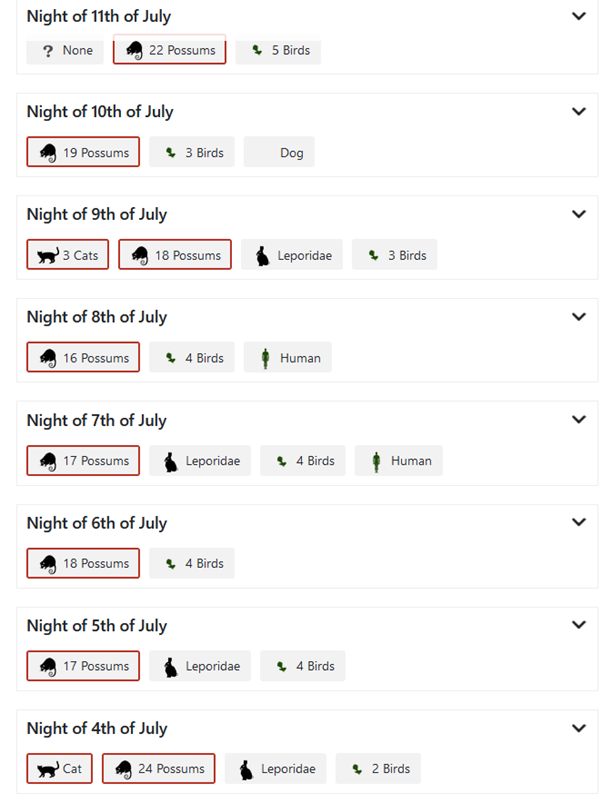
Table of predator densities produced by DOC AI camera
The trail camera over this period took 689 photos to look at. I’d forgotten just how painful it is to look through this number of photos! Anyway the summary of a detailed comparison highlighted the following things.
The trail camera in this setting saw about the same number of mid sized predators (possums and cats)
The trail camera missed all of the smaller animals (birds and rodents in other tests at same spot)
It is vastly less work when AI does the work and automatically calculates the predator densities
The AI was 100% accurate
With the trail camera there is no easy way to know if possums photos with a time difference are the same one or a new one. Lots of people have rules of thumb about how they would convert the 600+ photos into a number of possums seen. This difference is amplified by different types of trail cameras, different sensitivity settings and different interpretations of how to convert photo numbers into a predator count. The AI on the DOC AI cam has a consistent way of converting a sequence of videos into a number of predator visits (see description above)
If you are trying to work out predator density then there really isn’t much point in having a camera in one spot for more than about a week or two because it becomes quite consistent. This means one camera can be moved around a large area to easily build up an accurate picture of predators densities i.e. need fewer cameras
If you want to understand what the predators are doing then the video is much more insightful than a sequence of photos
If you are doing monitoring for incursion then the DOC AI camera has advantages in that it is way more sensitive and it can give you instant notifications as well.
”Great tool for a needle in a haystack job. 3 minutes from correctly identified detection of the target until I get an email notification. It's a game changer”
Greg van der Lee - DOC
Value of having a consistent way of monitoring predators.
At the moment there are different best practice ways of monitoring different predators from tracking tunnels, chew cards, Residual Trap Catch (RTC) for possums and trail cameras (as above). All of these methods and various levels of consistency depending on the skill of the person doing the monitoring and all take considerable labour. This can all be replaced by a DOC AI cam that is vastly more sensitive, more consistent and dramatically less work. All predators can have the same density index of the number of visits per day calculated automatically for all predators.
The other huge advantage is that all of the data is automatically tagged, uploaded (via phone app or cell) stored and backed up in the cloud so no more trying to manage sim cards and set times, GPS coordinates etc.
Very shortly this same device will also do the same for your bird monitoring. All the hardware (microphone etc) is in the current DOC AI cam and the software is being tested at the moment. The bird monitoring AI has 8+ years of learning makes this part of understanding what is happening to bird numbers vastly easier.
Previous analysis by DOC showed that if you count the cost of labour and then the camera is lower cost than a “cheap trail camera” This new version is less than half the price and more sophisticated meaning that if you value your time at all this is also likely to be the cheapest predator and bird monitoring system as well.