
Multiple uses of High Interaction Rate Trap (HIRT)
The design of the High Interaction Rate Trap (HIRT) trap has come from watching many thousands of videos of predators avoiding more traditional traps . This trap is not designed for backyard trapping or typical suppression but aimed at maintaining or achieving total eradication.
The HIRT trap has the following set of features that can be combined to allow a range of the more difficult conservation objectives:
Large open trap entrance set on the ground - so it has a higher catch rate for all predator types. Most traps and poison bait stations have small or custom entrances or they are up a tree so they only get interactions from predators rather than non-targets. This means that many devices have a low interaction rate (lots or predators just walk by). The larger entrance can be placed on natural highways in the bush and essentially makes it a much higher catch rate than live capture trap.
Motion sensor over large area - there is a motion sensor in the trap rather than a mechanical trip plate that is more sensitive and increases the catch rate.
Automatically re settable, fast, safe mechanism. This means that the trap can do multiple catches. The snap up blind mechanism was designed to be super fast as well as non-damaging if the predator is part way in (when this occasionally happens the predators typically pull themselves into the trap). When the trap goes off the predator gets frightened and immediately goes into a holding cage (there can be multiple holding cages). This also allows the trap to be reopened after one catch so other animals can continue to travel through the trap.
Easy to carry - The trap expands similar to a tent and has a low weight spool mechanism that is vastly lighter than the previous automated mechanism.
Hazing to guide animals into the large entrance. Hazing is an old idea but combined with a trap with a wide entrance it looks to be a very effective tool when combined with natural contours of the land that predators travel on. If combined with some bait and the trap is not activated then “safe” scent trails are established through the trap.
Link to existing kill devices. When a predator is captured it can guide them into any existing kill trap that they may have otherwise walked past. The only way out is via this kill trap.
Trap link to DOC AI cam that only activates when a predator is detected by AI (wire/Bluetooth). A key thing that makes the traps powerful is the ability to let non-targets walk through it and only activate for targeted predators. This means it can be set on commonly used pathways and non-target scent trails can act as a lure for the predators.
Different types of covers (e.g. permanent/walkover) - There are a wide number of ways the trap can be set up with hazing, different covered materials, colours or permanent set ups. For example in settings where humans or deer use a path or bridge the trap can have a wooden top that acts as a step that larger animals can walk over while smaller predators go through the gap in the bottom.
Automated door activation - this door to the holding cage can be automatically reopened that allows a number of different set ups. For example it can be set to automatically open after a certain amount of time which could be useful for releasing non-targets that are accidentally caught. Or the door can be activated remotely when a human confirms the species (kill or release)
Multi kill all predator species - this is really only useful for suppression in areas with lots of predators. It is also quite difficult to get humane kills for all predator types and also be self resetting. Ideally will be able to fit one of the kill mechanisms from NZ autotrap or Boffa Miskel or SpitFire that aim/claim to be able to kill all predator types. This then becomes the ultimate trap that can catch and kill all predator types at a much higher rate than any other device. When combined with the AI it allows means there are virtually no non-target species trapped either.
Solar powered - this is ideal for permanent installations where you want constant surveillance and catching.
Remotely communicate with the trap to see what is happening and send instructions to the trap - for example if the trap has activated and you can see what it is you can choose to activate kill or release. It will also be possible to change the setup of the trap for example from primarily monitoring (low power) to higher alert if there is a known reinvasion etc (higher sensitivity trigger and detection). The aim is to work with OneNZ satellite system so that this can be done anywhere in the country.
Link to Phone app for set up - this means the trap does not need lots of buttons or screen but can be set up and tested via the app.
Automated software updates - we are constantly making improvements and the software improvements will be available for free over time. Always happy to hear what you would most like to see next.
Better trigger - currently the motion sensor is much better than a trip plate or beam trigger but it could be improved further by a combination of triggers or using the thermal camera AI as a trigger mechanism (the trap would only trigger when the camera “sees” the predator fully inside the trap). As an example the current motion sensor is great for larger predators but can miss some rats that hug the inside of the trap. The thermal camera trigger would improve triggering in this case.
This unique set of features means the trap can be set up in a number of ways. Below is a list of what the trap can be used for
Permanent re-invasion management (notify, catch) - this is ideal for the end of predator proof fences or areas where re-invasion is most likely to occur eg beach near closest land or wharf eg. It is also ideal for highly traveled paths in predator proof areas e.g. bridges, ridges, waterways etc. The trap can be powered by solar power continually looking for specific species (eg rats, stoats, cats). Non-target species can travel through the trap without it being activated. When activated this version of the trap needs to be checked with manual elimination.
Remote permanent re-invasion management (notify, catch and kill/release). Same as above but can be linked to existing kill mechanisms. For example if you are targeting stoats in a Kiwi area then when the trap activates the holding cage has one exit via a traditional DOC 250 etc so the kill can happen remotely i.e. no need to clear the live capture cage. If a non-target like kiwi is accidentally trapped in the live capture it will open after a certain time and they obviously will not be able to get into the kill mechanism.
Mobile re-invasion management (multiple mobile devices rapidly deployed). This is a flexible set of traps and cameras that is easily moved and can be set up in a number of ways depending on the terrain and target species.
Catching the last hard to catch predators (AI trigger catch). Often the best trap for catching the last hard to catch predators is a live capture cage. The more open HIRT has been up to 10 times catch rates due to the larger open area. Linking this to the AI trigger also allows it to be in areas with non-target species so they can walk through the traps without triggering it. This also creates scent trails that the predators often follow.
Micro sanctuaries - for example permanent protection of high value nesting areas. In some cases there are species of such high value that each nesting area is worth protecting. Individual nests or nesting areas can have a combination of hazing, netting combined with a DOC AI camera and HIRT trap to mean any predators visiting a nesting area will be eliminated.
High density predator suppression/elimination (multi catch and kill of all predator types that is moved through an area). The most common way to do predator suppression is to have a large number of cheap traps or bait stations designed to stay in the area indefinitely (because they won’t remove all predators). We believe that a cheaper way to achieve the same or improved suppression could be to have a much lower number of HIRT traps that are moved through an area once they have caught ALL the local predators. The average number of catches per trap per year for the best monitored projects in New Zealand is a little under 2. Devices like NZ autotrap or Boffa Miskel AI trap can work well where there are high densities of predators because the predators can create scent trails. When the predator densities get lower these sorts of strategies are less useful as most predators don’t go up every tree they walk past
Customisable catching platform - custom setup to identify, catch and kill any predators - eg wild pigs, wallabies etc. The tools created are very flexible in terms of what they can identify and then link to. Some of the examples include identifying wallabies crossing bridges and playing a barking dog that makes them turn around and go back. The camera can be linked to larger traps like pig traps etc.
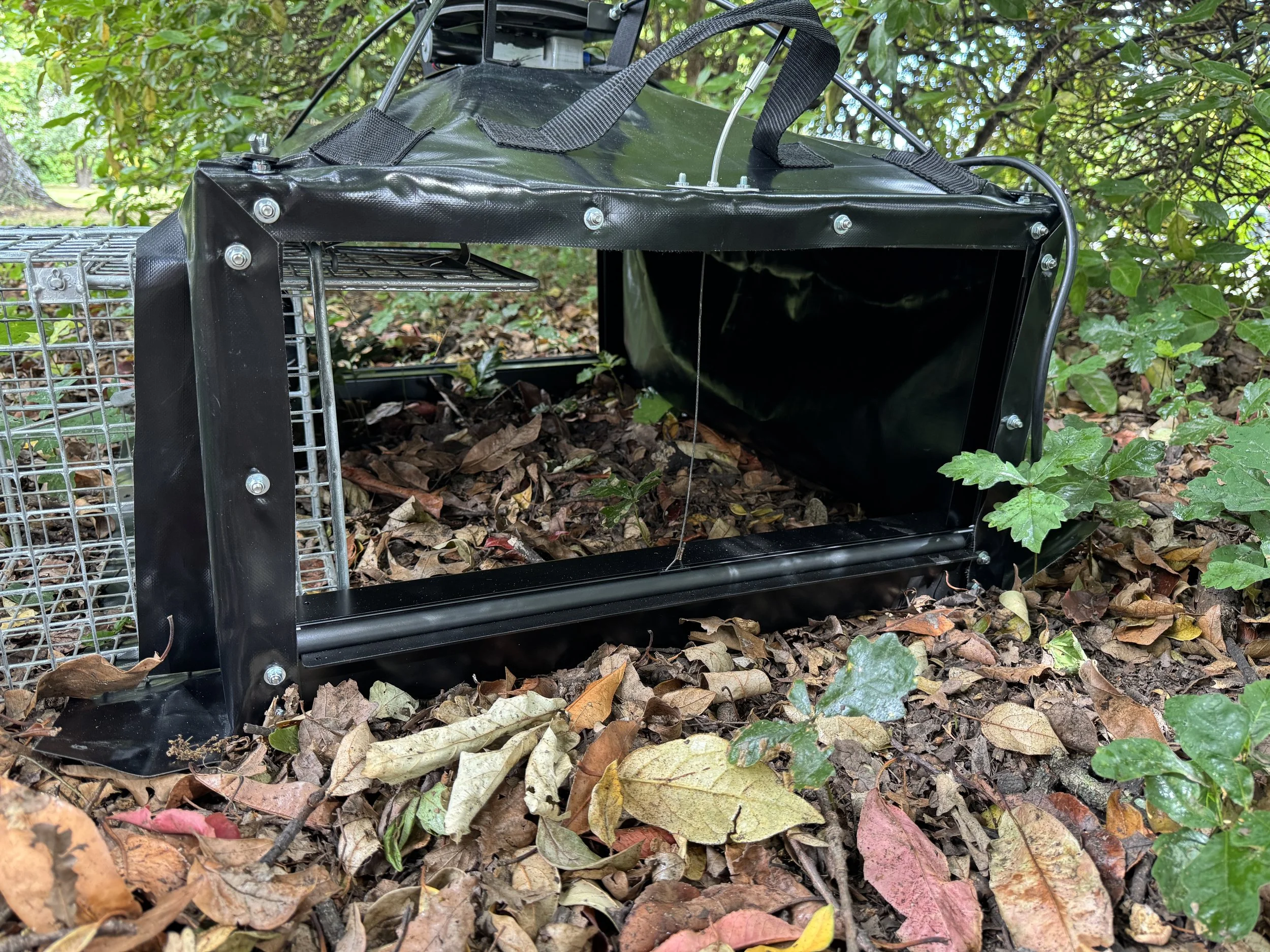
The trap has a wide open entrance
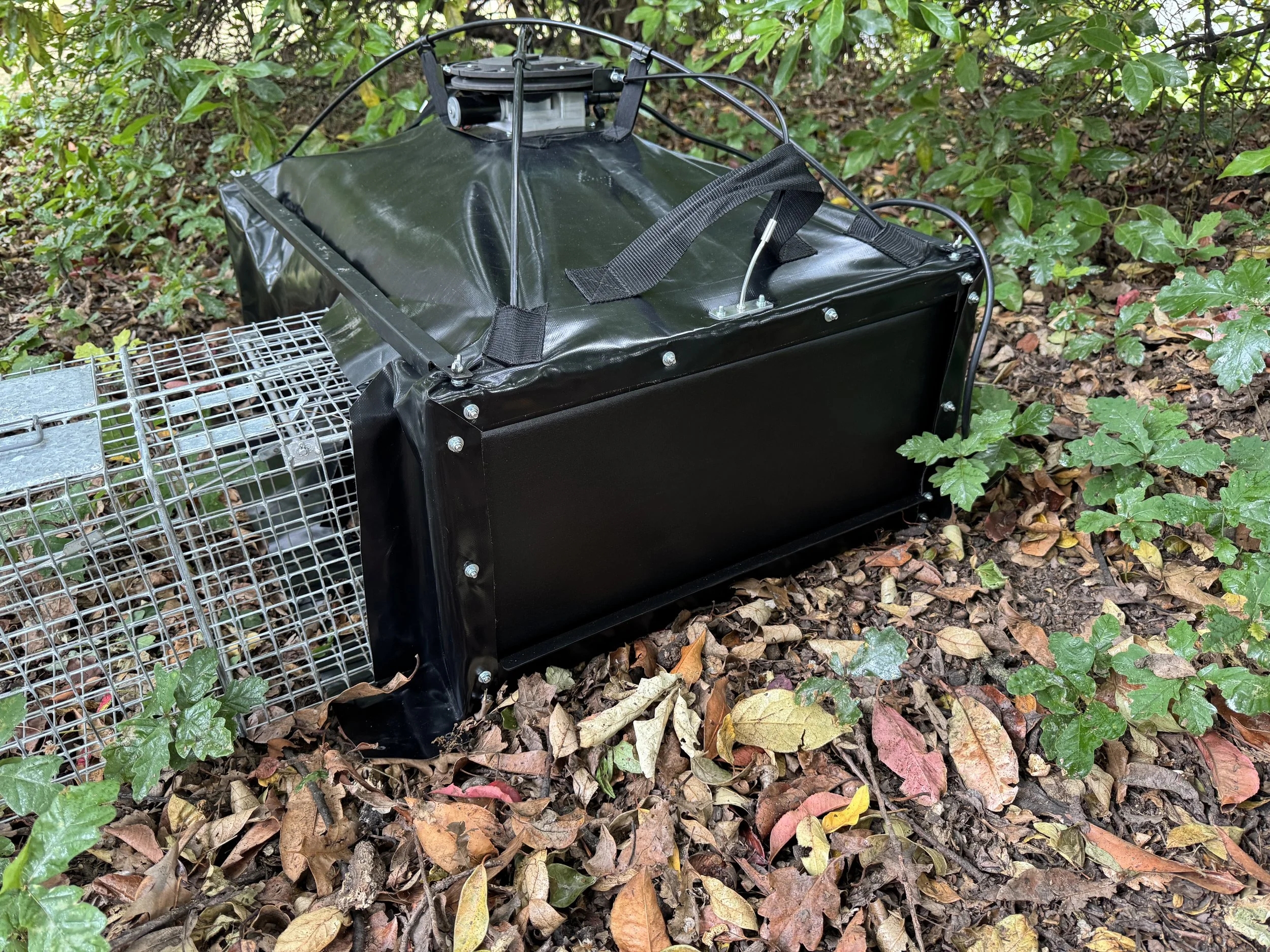
When the blinds snap up the predator is guided in a traditional cage on the side. There can be multiple cages for multicatches.
Video showing the trap in action. It can auto reset multiple times and be linked to an AI camera so it only triggers when it sees a predator. The non-targets scent trails act as the lure. Typically there is hazing on either side of the trap to guide animals through the trap.
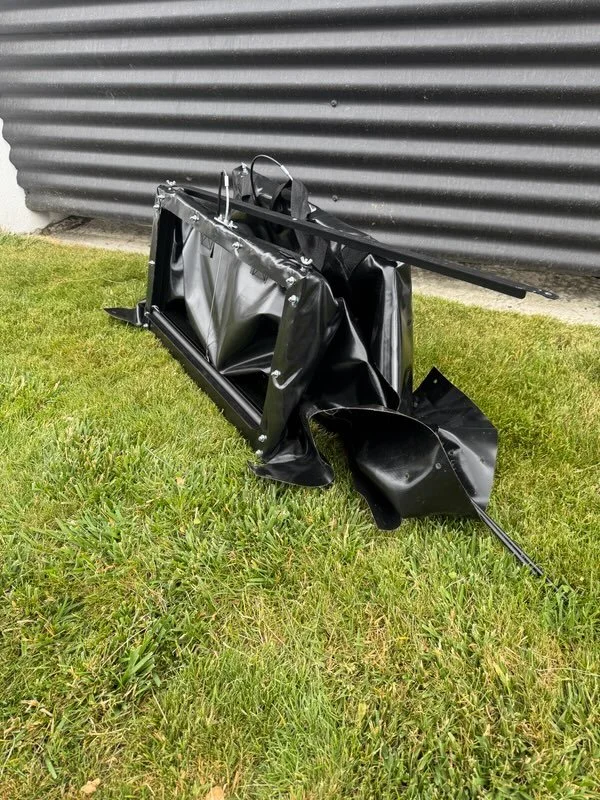
Trap folds up for easy carrying.